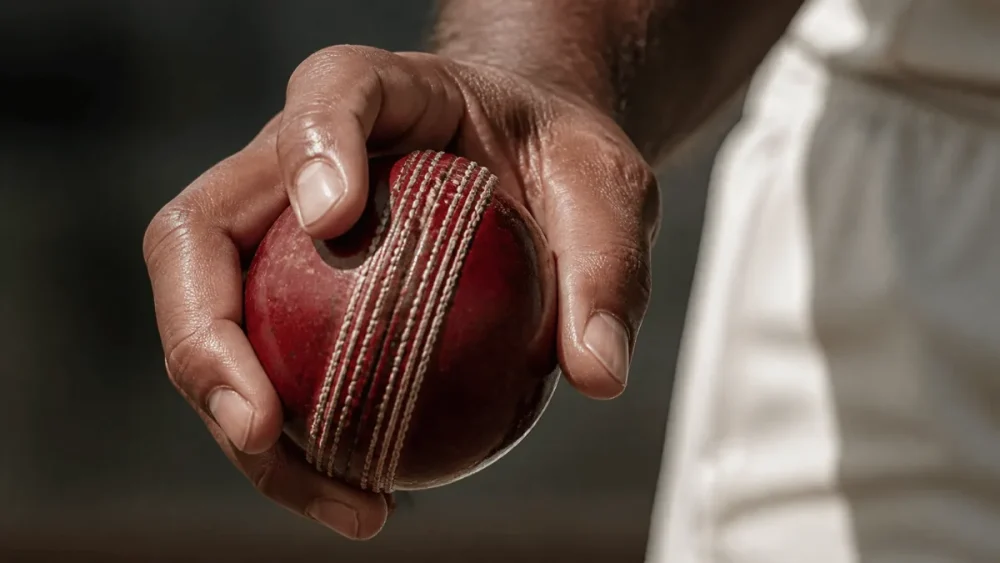
A cricket ball is a sphere with a raised seam running round its middle. Thrown by anyone, it travels in a straight line. Bowled properly, it can curve through the air by a foot or more, and nobody holding a bat enjoys that very much at all.
Swing is the oldest and most reliable advantage a fast bowler has, and unlike reverse swing it works with a new ball in ordinary conditions. What follows is how the movement is produced, how the two basic deliveries are gripped, and why the same ball behaves differently at different times of day.
Why the Ball Moves at All
Air passing over a cricket ball does not behave identically on both sides, and swing is what happens when that asymmetry is deliberate rather than accidental.
The bowler polishes one side of the ball and allows the other to roughen. The seam is then angled slightly to one side rather than pointing straight down the pitch. As the ball travels, the air flowing over the smooth side stays attached to the surface longer than the air on the rough side, which separates earlier. The resulting pressure difference pushes the ball sideways, towards the rough side.
That is the whole mechanism, and it explains every practical detail that follows. Shine one side, angle the seam, and the ball moves away from the shine.
The Three Things That Have to Be Right
- A genuine difference between the two sides. One polished, one left alone. A ball shiny on both sides or scuffed on both sides will not swing conventionally.
- A stable seam angle. The seam must stay pointing in the same direction through the whole flight. A ball that wobbles presents both sides equally and the effect cancels out.
- Enough pace, but not too much. Below a certain speed there is not enough airflow to generate the pressure difference. Above a certain speed the airflow goes turbulent on both sides and conventional swing stops working.
The third point is the one that surprises people. A genuinely quick bowler can bowl himself out of conventional swing, which is why some of the best exponents of the art have operated in the mid eighties rather than the mid nineties.
The Outswinger
What it does
For a right handed batter, the outswinger starts on or around off stump and moves away towards the slips. It is the wicket taking ball of the pair, because it draws the batter into a shot and then leaves him, finding the edge.
How it is gripped
First two fingers either side of the seam, close together, with the seam angled towards the slip cordon. The shiny side faces the leg side. Thumb resting on the seam underneath, not gripping hard. The wrist stays upright and behind the ball through release.
What usually goes wrong
The commonest fault is the wrist falling away to the off side at release, which drops the seam and kills the angle. The second is gripping too tightly, which produces a wobble rather than a stable seam position.
The Inswinger
What it does
The mirror image. It starts outside off and comes back towards the pads, and it is the ball that produces leg before and bowled rather than caught behind. Against a batter who has been pushed across his stumps by a run of outswingers, it is close to unplayable.
How it is gripped
The same two fingers either side of the seam, but the seam is now angled towards fine leg and the shiny side faces the off side. Some bowlers shift the grip slightly across the seam to help. The wrist must stay behind the ball, and the bowling arm tends to be a fraction lower than for the outswinger.
What usually goes wrong
Bowlers chasing inswing often drop the arm too far, which turns the delivery into a low full toss down the leg side. The other frequent error is over rotating the wrist, which produces a ball that starts outside leg and swings further away from the stumps.
The Two Side by Side
| Outswinger | Inswinger | |
|---|---|---|
| Movement, right hand batter | Away towards slip | In towards the pads |
| Seam angled towards | Slip cordon | Fine leg |
| Shiny side faces | Leg side | Off side |
| Typical dismissal | Caught behind or at slip | Bowled or leg before |
| Best length | Slightly fuller than good length | Full, attacking the stumps |
| Main risk | Too wide, easily left | Drifting down the leg side |
Conditions That Help
Swing is famously unpredictable, and bowlers talk about it the way farmers talk about rain. Several factors genuinely matter.
- Cloud cover, which is the condition every commentator mentions and which bowlers swear by, even though the physics behind it remains argued over
- Heavy, humid air rather than thin dry air
- A ball with a pronounced seam, which is why different ball manufacturers produce noticeably different amounts of movement
- A surface with enough grass to keep one side from scuffing too quickly
- Early morning sessions, before the outfield has dried and roughened the ball
What does not help is a hard, dry, abrasive outfield, which destroys the shine within fifteen overs and ends the conventional swing phase of the innings early.
Reading It From the Stands
You can usually tell which way a bowler is trying to swing it before the ball is halfway down, if you know where to look.
Watch the wrist at release rather than the ball. An upright wrist with the fingers finishing towards the slips is an outswinger. A wrist rolled slightly behind with the arm a fraction lower is an inswinger. Watch the keeper and the slips too: a cordon that shuffles a yard wider is expecting the ball to go away.
The best indicator of all is the shine. If you can see which side of the ball is catching the light as the bowler runs in, you know which way it should move, because it moves away from the shine.
Why It Still Decides Matches
Batting techniques have been rebuilt around pace and spin over the past two decades, and the modern player handles both better than his predecessors did. Swing has proved more stubborn, because the movement happens before the ball pitches and therefore before the batter has any information from the surface to work with.
A ball that deviates late in the air gives the batter nothing to read. That is why a bowler of ordinary pace who swings it both ways remains one of the most valuable commodities in the game, and why a new ball in heavy conditions is still worth more than any amount of reverse later on.