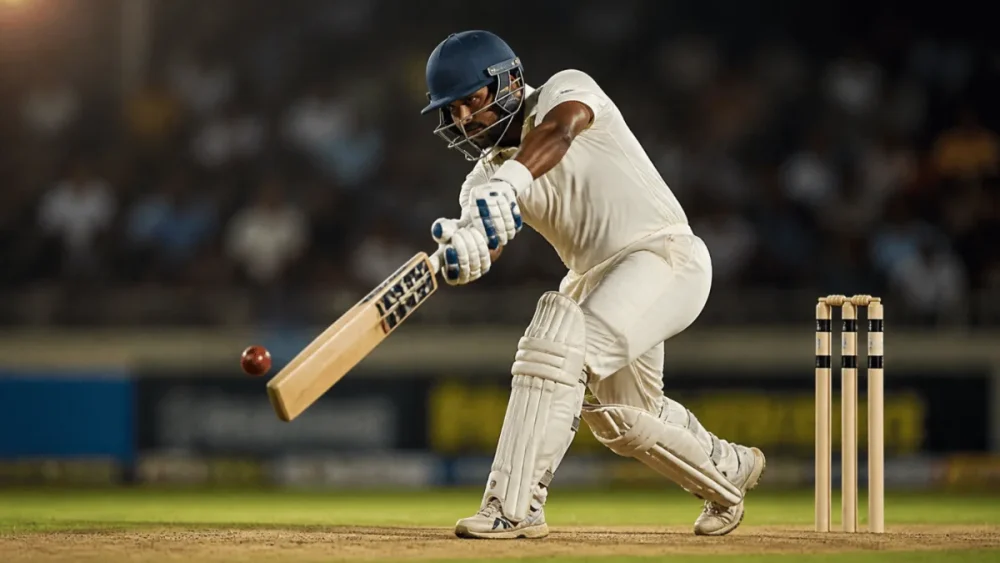
Ask a crowd which cricket shot they would most like to be able to play and the cover drive wins almost every time. It is the one stroke that survives in the memory long after the score has been forgotten: the front foot going forward, the bat coming down straight, the ball running away between cover and mid off with nobody moving.
It is also the shot that gets more good batters out than any other. The same movement that produces the picture produces the edge, because a cover drive asks you to play away from your body at a ball that may still be moving. This piece builds the shot from the ground up, one component at a time, then sets out the faults that cause each of the common dismissals.
What the Shot Actually Is
A cover drive is a front foot attacking stroke played at a full ball outside off stump, hit through the arc between cover and extra cover. The bat swings through the line of the ball rather than across it, and the ball is struck under the eyes with the face of the bat pointing where it is meant to go.
That definition contains the whole difficulty. The ball has to be full enough to drive, wide enough to free the arms, and close enough to reach without lunging. Miss any of those three and the stroke that follows is not a cover drive, it is a push at a ball you should have left.
Building the Shot in Five Parts
1. The stance you start from
Feet about shoulder width apart, weight evenly distributed or very slightly forward, knees soft rather than locked. The head should be still and level, both eyes looking down the pitch rather than one eye leading. A head that tilts at the point of release will take the shoulders with it.
Grip the bat with the hands close together in the middle of the handle, the top hand doing most of the work. A dominant bottom hand is the single most common reason a drive goes square rather than through cover.
2. The trigger movement
Most batters make a small preparatory movement as the bowler loads, usually a half step back and across towards off stump. The purpose is not to go anywhere in particular. It is to be moving rather than rooted when the decision arrives, because a body already in motion can commit faster than one starting from stillness.
Keep it small. A large trigger movement eats the time you need for the actual stride and leaves you reaching.
3. The stride
The front foot goes towards the pitch of the ball, not simply down the pitch. If the ball is wide, the stride is wider. If it is straighter, the stride is straighter. The foot should land with the toe pointing roughly towards cover rather than square on, which opens the hip and lets the bat swing through freely.
The length matters less than people think. A short, firm stride that gets the head over the ball beats a long one that leaves the weight behind the front knee.
4. The contact
Here is the test of whether the shot is right. At the moment of contact the head should be above or just outside the front knee, the hands should be ahead of the ball, and the bat face should be pointing in the direction you want the ball to travel.
The ball is struck beside the front foot, not behind it. A ball struck level with the back foot has been played too late and will go square. A ball reached for in front of the stride has been played too early and will go in the air.
5. The follow through
The bat continues high, the shoulders rotate, and the weight finishes over the front leg. A follow through that stops abruptly usually means the bottom hand took over at the last instant, which closes the face and drags the ball to midwicket.
The follow through does not make the shot. It reports on it. If the finish looks wrong, the problem happened earlier.
Fault Finding
Almost every poor cover drive traces back to one of six errors. The table below matches the symptom to the cause.
| What happened | Most likely cause | The fix |
|---|---|---|
| Edged to the slips | Playing away from the body at a ball not full enough | Let the ball come, or leave it |
| Ball went square to point | Hit too late, beside the back foot | Stride earlier, meet it beside the front foot |
| Chopped on to the stumps | Bottom hand closed the face at contact | Top hand leads, lighter bottom hand grip |
| Caught at mid off in the air | Head fell away, weight stayed back | Head over the ball, weight through the front knee |
| Inside edge on to the pad | Stride went down the pitch rather than to the ball | Front foot towards the pitch of the delivery |
| Missed it completely | Trigger movement too large, late into position | Shorten the trigger, start the stride sooner |
When Not to Play It
The hardest part of the cover drive is knowing when to leave it alone, and the best players in the world are separated from the rest largely by this judgement rather than by technique.
- Early in an innings against a moving ball, when the length looks driveable but the movement has not finished
- On a pitch with uneven bounce, where a ball you expect to hit at waist height arrives at thigh height
- Against a bowler bringing it back in, where the gap between bat and pad becomes the target
- Immediately after a wicket, when the bowler is bowling fuller and wider on purpose to invite exactly this stroke
- When the field has a deep point and a short cover, which is a captain telling you the drive is the plan
A good working rule for the first twenty balls of an innings: if you are not certain it is full enough, it is not full enough.
Practising It Properly
Throwdowns and the bowling machine both have a weakness, which is that they deliver the ball at a predictable length. That trains the movement but not the decision, and the decision is the harder half.
- Start with ten balls from a short distance, hit along the ground, focusing only on head position at contact
- Move to a mixed feed where roughly one ball in three is deliberately too short to drive, and count the leaves rather than the drives
- Put a cone where cover would field and aim to beat it on either side, which forces the face to stay open or close deliberately rather than by accident
- Finish with a short set against a genuinely fast feed, where the only goal is to stay still and play late
The second exercise is the one most players skip and the one that matters most. Learning to drive is easy. Learning not to is what keeps you in.
Why It Is Worth the Risk
Given how many batters it dismisses, there is a reasonable argument for not playing the cover drive at all until you are set. Plenty of successful players have done exactly that and built long careers on leaving everything outside off stump for an hour.
But the shot has a value beyond its runs. A bowler who sees a cover drive go for four has to decide whether to pull the length back, and a length pulled back is a length you can work off your pads. One good drive changes the next six balls, which is why batters keep playing it even knowing what it costs.