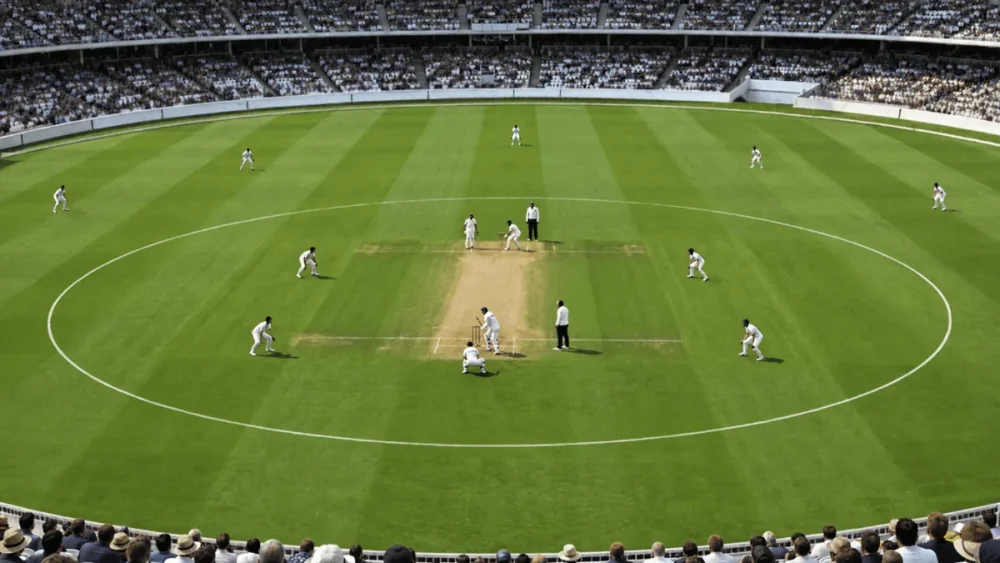
There is a white circle painted on the outfield of every limited overs ground, thirty yards from the middle of the pitch. For most of a match it is scenery. For certain overs it is the single most important marking on the field, because the number of fielders allowed outside it changes, and with it the entire shape of the contest.
Those overs are the powerplay. The rules are short, the consequences are not, and a viewer who knows which phase is in progress can read a limited overs innings far more accurately than one watching the score alone.
Over 1 to Over 6: The T20 Powerplay
In a Twenty20 international the first six overs are the powerplay, and during them only two fielders may stand outside the thirty yard circle.
Two fielders out means seven inside, which means the boundary is effectively open in most directions. A batter who connects cleanly in the first six overs is scoring four rather than one, and the arithmetic of the entire innings is built on that.
What it produces is a phase that looks reckless and is not. Sides accept a high chance of losing wickets because the runs available are worth more than the wickets risked. A T20 opener who makes 30 from 14 balls and is caught in the deep has done his job exactly as intended.
Over 7 to Over 20: After the Circle Opens
From the seventh over onwards, five fielders may stand outside the circle. The change is dramatic. Two out becomes five out, the gaps close, and the same shot that cleared a ring fielder in over four now finds a man on the rope.
The middle of a T20 innings is therefore a negotiation about singles rather than boundaries, and the sides that win regularly are usually the ones that score fastest between overs seven and fifteen rather than during the powerplay itself.
The ODI Phases
A fifty over innings has three phases rather than two, and the limits step up at each change.
| Overs | Fielders allowed outside the circle | What it produces |
|---|---|---|
| 1 to 10 | 2 | Attacking fields, new ball moving, high risk on both sides |
| 11 to 40 | 4 | Spin and containment, singles rather than boundaries |
| 41 to 50 | 5 | The death overs, boundary riders set, yorkers and ramps |
The middle block is the longest and the one casual viewers find dullest, which is precisely why it decides so many matches. Thirty overs with four fielders out is where a side either builds a platform or quietly loses the game without anything dramatic appearing on the scoreboard.
What Tests Do Instead
There is no circle restriction in Test cricket at all. A captain may place his nine fielders anywhere he likes, subject only to the Law limiting fielders behind square on the leg side to two.
That freedom is why Test fields look so different: three slips and a gully with nobody saving the single, or a ring of catchers pressed in around the bat for a spinner. Neither arrangement would be legal in the first six overs of a T20 and neither would make sense in the last ten of an ODI.
How the Rules Got Here
Fielding restrictions were introduced to stop a problem that was making one day cricket unwatchable. Without them, a captain defending a total simply pushed every fielder to the boundary, conceded singles indefinitely, and strangled the innings. The circle exists to force a period in which that is impossible.
The specific numbers have been adjusted repeatedly over the years, including an experiment with a batting side choosing when to take a block of overs, which was eventually dropped. The direction of travel has generally been towards favouring the batting side, and scoring rates have risen accordingly.
Reading a Powerplay From the Stands
A few things are worth watching for, because the field tells you the plan before the ball is bowled.
- In a T20 powerplay, where the two outside fielders are placed tells you which shot the bowler is willing to concede
- A side that keeps a slip in during the powerplay is still hunting wickets rather than containing
- In an ODI, watch for the moment the fourth fielder goes out at the start of over eleven, which almost always coincides with a change of bowler
- In the last ten overs, count the boundary riders before the ball is bowled: five out and a deep point usually means a wide yorker is coming
- A captain who brings a fielder up inside the circle in the death overs is inviting a single to protect the boundary, which is a sign the equation has tightened
Why the Phase Structure Matters More Than the Totals
Scores in limited overs cricket have climbed steeply, and the usual explanations are bats, boundaries and batting depth. The fielding restrictions deserve more credit than they get.
A format that guarantees a period with only two fielders outside the circle guarantees a period in which attacking batting is mathematically correct. Everything downstream, from the aggressive opener to the pinch hitter to the modern habit of batting deep and swinging from the first ball, follows from a rule about where men may stand.
Which is a reasonable summary of why the white circle is worth knowing about. It is the only piece of paint on a cricket ground that changes how the game is played.